
HRIS vs HRMS vs HCM: What Philippine Companies Actually Need
Think about the last time an employee moved from one branch to another. A straightforward change, at least on paper.
Someone updates the employee record. Someone else informs payroll. The new manager needs access to approve leave, while attendance may still sit under the old branch. If an update gets missed, the employee could discover it on their payslip before HR knows anything went wrong.
Before long, a single transfer has become a string of emails, spreadsheet updates and reminders.
It is often in moments like these that an HR team starts thinking: surely there is a better way to connect all of this.
Then the search begins. One provider offers an HRIS. Another recommends an HRMS. A third says your business needs HCM. Their feature lists look surprisingly similar, yet each seems to describe something different.
So, what separates them? And which does your company actually need?
For Philippine businesses managing multiple locations, demanding payroll processes and a growing workforce, understanding these terms helps. But the more useful starting point is understanding what you need your system to do.
What is the difference between HRIS, HRMS and HCM?
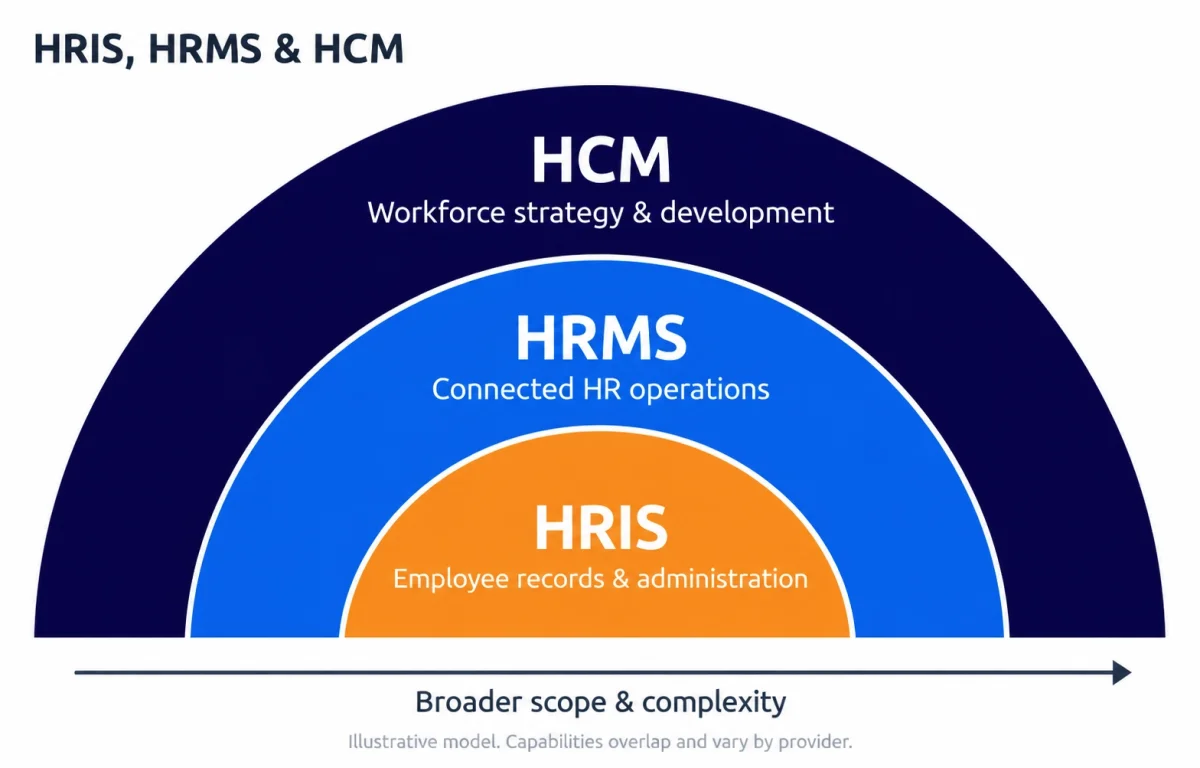
HRIS, HRMS and HCM describe overlapping approaches to managing employee information, HR operations and workforce development. HRIS usually emphasises employee records and administration. HRMS often describes a broader set of operational HR processes. HCM puts greater emphasis on managing and developing the workforce alongside those operations.
These are useful distinctions, but they are not fixed product specifications. Vendors use the terms differently, and a system sold as an HRIS may include capabilities another vendor markets as HCM. SAP also notes that the terms are often used interchangeably.
For Philippine companies, the practical question is which combination of employee records, attendance, payroll, talent and reporting will support the business. The acronym alone cannot answer that.
HRIS vs HRMS vs HCM at a glance
| Term | Full name | Usual emphasis | What buyers should verify |
|---|---|---|---|
| HRIS | Human Resource Information System | Reliable employee information and core HR administration | Which processes work from the employee record, including leave, self-service, attendance and payroll where offered |
| HRMS | Human Resource Management System | Managing recurring HR operations across connected processes | How transactions, approvals, attendance and payroll work together, and where manual handoffs remain |
| HCM | Human Capital Management | Connecting HR operations with workforce development and planning | Whether recruitment, performance, learning, succession and analytics meet actual business needs |
Use these descriptions to understand a vendor’s language. Use a written scope to establish what you are buying.
Payroll, for example, should never be assumed to be included simply because a product is called an HRMS or HCM suite. Confirm the relevant country coverage, licensed modules and delivery responsibilities separately.
What is an HRIS?
An HRIS provides a structured way to maintain employee information and administer HR processes. The employee record is its foundation: who the employee is, where they work, whom they report to and what changes throughout their employment.
Depending on the product and package, an HRIS may also support leave, employee self-service, document management, attendance, payroll or recruitment. That variation is why a simple feature checklist can be misleading.
In the branch-transfer example, a dependable employee record gives each authorised team a consistent view of the change. The effective date, reporting line and assigned location should be clear, rather than reconstructed from separate messages.
The immediate requirement is a reliable employee record with controlled changes and clear ownership. Buying more modules will not resolve inconsistent records unless the implementation also addresses how those records are maintained.
An HRIS-focused project may therefore be the right starting point when the biggest problem is fragmented information, repetitive administration or unreliable reporting. For a fuller introduction to the category, see What is an HRIS?
What is an HRMS?
An HRMS generally describes software used to manage a wider range of HR operations. Alongside employee records, the conversation often includes attendance, leave, payroll, benefits and approval workflows.
The useful distinction is operational connection. Can an approved transaction move through the relevant processes without someone rebuilding it in a spreadsheet?
Consider an employee who changes shifts during a payroll period. The business needs the correct roster, attendance treatment, approval history and payroll inputs. A system that displays all four areas in separate menus may still leave the payroll team reconciling them manually.
For an organisation with recurring cut-off problems, the requirement is a controlled process from attendance capture through payroll review. HRMS is a useful search term for that need, but the workflow matters more than the label.
What is HCM?
Human capital management is a broader approach to managing the workforce, supported by policies, processes and technology. HCM software typically brings operational HR together with capabilities such as recruitment, performance, learning, succession and workforce planning (Oracle).
For example, a growing manufacturer may already have dependable employee records and payroll. Its next challenge could be preparing supervisors for new production lines, identifying skills gaps or building succession coverage for critical roles.
Those needs justify looking beyond administration. The company must connect workforce information with the decisions managers need to make about hiring, development and deployment.
However, purchasing an HCM suite does not create a talent strategy. Performance reviews still need clear goals. Succession planning still needs management judgement. Workforce planning still needs agreed assumptions and budgets.
The software should support those decisions and make the underlying information usable.
What should Philippine companies prioritise?
Start with the processes that create the greatest operational exposure or prevent the business from growing. Employee count matters, but workforce complexity and management needs often reveal more.
A 250-person hospitality business with rotating shifts and several locations may have more demanding attendance-to-payroll requirements than a larger company with standard office schedules.
Establish a dependable employee record
Check how the system handles organisational structures, reporting lines, employment changes and access to sensitive information.
Ask who can make a change, who approves it and when it takes effect. Establish which system owns each data field if HR, payroll and finance remain separate.
A central database is useful only when people can trust how its information is maintained.
Try the interactive demo: PeoplesHR HR demos. See how PeoplesHR sets up salary grades, corporate titles and your org chart hierarchy.
Define the attendance-to-payroll scope
For Philippine operations, ask vendors to demonstrate the treatment of your applicable overtime, night differential, holiday and rest-day scenarios, together with relevant payroll deductions and statutory outputs.
This is a scope and validation exercise, rather than a calculation guide. Your payroll specialists should define the applicable rules and expected results before testing begins.
Separate calculation from filing and remittance. Generating an output does not establish who reviews, submits or pays it. Likewise, an integration with a payroll provider is a different delivery model from payroll processed inside the platform.
Document those responsibilities before signing.
Make employee and manager access practical
Assess how employees will check information, submit requests and resolve errors across your actual locations and working arrangements.
Managers need a workable way to review exceptions and approve transactions. Employees need access appropriate to their roles and available devices. HR needs visibility into requests that are waiting or have been rejected.
A feature is valuable when people can use it consistently within the working day.
Add talent capabilities against a defined need
Recruitment, performance, learning and succession become meaningful investments when there is a process owner and a clear decision to improve.
For example, a performance module might support more consistent goal reviews across branches. Succession tools might help leaders assess readiness for roles that are difficult to replace.
Specify that purpose before deciding which modules belong in the first rollout.
Which scope fits your current situation?
The following examples are illustrative, rather than employee-count rules.
| Your situation | A sensible starting scope | What to establish before expanding |
|---|---|---|
| Employee information is scattered across files | Core HR, controlled employee changes and essential self-service | Data ownership, record quality and reliable reporting |
| Cut-off work depends on manual attendance reconciliation | Core HR plus connected time, leave and payroll processes | Rules, exception handling, approvals and reconciliation |
| Recruitment and performance processes are inconsistent | Operational HR plus the relevant talent capabilities | Process ownership, manager participation and usable measures |
| Several entities use different systems | Shared data standards, defined local processes and integration governance | Entity boundaries, local requirements and consolidated reporting |
| The business needs a broader workforce strategy | Operational foundations plus planning, development and analytics | Consistent definitions, accountable decision-makers and reliable source data |
You can phase these capabilities without treating HRIS, HRMS and HCM as three mandatory purchasing stages. The right sequence depends on business priorities and implementation capacity.
Decide between one platform and connected specialist systems
A broad platform can reduce handoffs when its modules share records and workflows. Specialist systems may be appropriate when a particular function has requirements that the broader platform cannot meet well enough.
Neither approach removes the need for governance.
If you retain separate systems, define the employee identifier, data owner, transfer schedule and error-resolution process. Decide how corrections move between systems and how teams reconcile differences before payroll closes.
If you select one platform, verify that the proposed modules actually share the required information. A common brand or login does not prove that every transaction flows automatically.
Compare the complete operating cost: subscriptions, implementation, interfaces, maintenance, reconciliation and the internal time needed to keep the process running.
Write the scope before comparing vendors
Turn the discussion into a short requirements document that HR, payroll, finance and IT can approve together.
For each priority process, capture:
- The problem: What fails, takes too long or requires repeated manual work?
- The required outcome: What must employees, managers or administrators be able to do?
- The system responsibility: Which application owns the record, calculation or approval?
- The acceptance evidence: Which transaction, output or reconciliation will demonstrate that it works?
- The rollout stage: Is it essential for launch, needed next or a future option?
For example, “attendance management” is too broad to guide a purchase. “Approved attendance corrections must reach payroll before cut-off, with an identifiable reviewer and a traceable adjustment” gives the team something concrete to evaluate.
Once the scope is agreed, use it to compare providers. Our guide to the best HRIS systems in the Philippines provides a framework for that next stage.
Where PeoplesHR fits
PeoplesHR presents its platform across HR, Time, Pay, Talent, Engagement, Recruitment and Insights. Its Philippine offering connects employee information, attendance and payroll, with additional capabilities for workforce development and reporting.
That breadth allows the evaluation to start with your operating priorities. A business addressing disconnected records and cut-off work will have a different initial scope from one introducing structured performance and succession processes.
Review the PeoplesHR Philippines offering against your requirements, then confirm module entitlements, configurations, integrations and implementation responsibilities in the proposal.
Watch the webinar: Fixing Philippines Payroll: What HR needs to get right in 2026. Where Philippine payroll most often goes wrong, and what to check before deciding your scope.
Frequently asked questions
Is HCM better than HRIS?
HCM usually describes a broader scope, but broader does not automatically mean better for your business. Choose the capabilities you need and can implement effectively. A dependable core HR and payroll process can deliver more immediate value than talent modules without clear owners or usable data.
Does an HRIS include Philippine payroll?
It may, but the term does not guarantee it. Confirm whether payroll is included, separately licensed, integrated with another provider or outside the scope. Validate the applicable Philippine requirements with your payroll team.
Can we keep our existing payroll system?
Potentially, if the systems can exchange the required information reliably. Check data ownership, interface availability, reconciliation, support responsibilities and what happens when a transfer fails. Include integration costs in the comparison.
Do we need to implement everything at once?
No. A phased rollout can focus first on the most urgent operational needs. Plan the shared data and integration requirements early so that later modules can build on the initial implementation.
What should we ask vendors first?
Ask them to map your priority processes to the exact proposed package. Identify what is included, what needs configuration, what depends on another system and what remains manual. That answer will tell you more than the acronym on the brochure.
Planning your next HR system? Talk to PeoplesHR about the HR, payroll and workforce capabilities your business needs now, and what should come next.