Key takeaways
What we covered
Pick a time to play the recording from that moment, right here on the page.
03:07
Everything has AI in it now
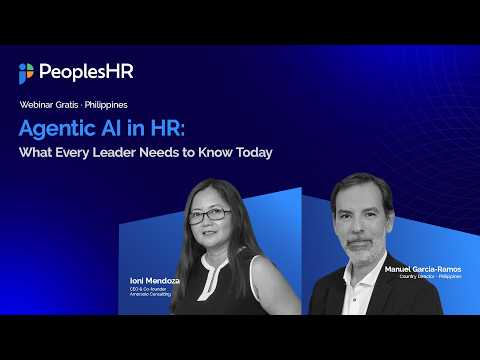
Manuel shows Lexi answering an overtime question in seconds, and why HR can't avoid the shift.
09:39
Why reskilling fails on its own
The incentives around the program still reward the old way of working.
12:15
Meet Eli Harrell
EmergePH and its approach: shifting behaviors that connect to KPIs, not just running trainings.
14:51
How companies measure AI today
Usage and licenses, and why that says little about business impact.
16:27
HR is rewriting the roles
Jobs are changing, not disappearing, and AI can teach people how to use it.
19:00
No industry is safe for long
Robot hotel check-ins in Japan and lights-out factories in China.
21:35
The Klarna story
An AI assistant that replaced agents, and the AI-capable people who were hired back.
23:56
The AI Behavior Benchmark
A 15-question market study across the five behaviors, with results due in November.
26:39
Executive gap readout
How leadership, middle management and frontline staff see the same behaviors differently.
35:00
Audience Q&A
Lowest-scoring behaviors, governance versus experimentation, replacing admin roles and BPO attrition.
Q&A highlights
Modeling, at an average of 6.6 out of 10. Value articulation and experimentation follow at 7, ownership at 7.1 and learning autonomy at 7.3. People are taking charge of their own learning, but rarely showing colleagues what they have built.
They aren't mutually exclusive. Governance matters in high-risk areas, but people need practice. Monthly hackathons, workshops or boot camps let them pick a problem, solve it with AI and show the result, without touching anything risky.
About a week. Once a senior leader completes it and shares their link, the gap report is generated as long as at least four people in the organization respond.
If a tool can do the same admin work for a fraction of the cost, businesses will shift. Tasks are going away, so people need to move up the value chain and build the skills the rewritten roles will need.
Yes, if you understand the problem first. One BPO used AI to score every call for QA, which freed QA leads to coach new hires through their first months. Manuel added that a flight-risk score built from pay, promotion, training and survey data shows who is likely to leave and why.
That's the next step. The benchmark is a 15-question market study. EmergePH's full audit goes deeper and evaluates proficiency from several angles.
See where your teams stand on AI
Watch the full session, or talk to us about bringing your HR data into one system with Lexi.